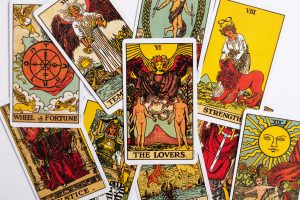
For decades, organisations assumed that more information would lead to better decisions and stronger consumer trust. But people don’t just seek facts or a good product, they seek meaning. The brands, communities and institutions that resonate today help individuals navigate uncertainty, express identity and feel part of something larger than themselves. This is why communities are more valuable than just an audience. Belonging often matters more than loyalty, and purpose continues to outperform purely functional messaging.
3 in 10 Americans now consult astrology, tarot cards or fortune tellers at least once a year with higher engagement among younger generations. Harris Poll, 2024
The question is why now?
Making sense of uncertainty
Gen Z has come of age during a period defined by economic instability, climate anxiety, political polarisation and technological disruption. Traditional markers of certainty like career paths, home ownership, stable institutions feel less predictable than they once did. When the ground shifts, people look for patterns.
In her recent essay on heartbreak and modern life, science journalist Lucy Jones argues that we increasingly seek meaning in environments that feel difficult to control.
Psychologists define magical thinking as the tendency to believe that thoughts, rituals or symbols can influence outcomes. Far from being irrational, research suggests it tends to emerge specifically during periods of stress, reduced control and heightened uncertainty. This is reinforced by foundational work from Langer (1975), studies showed that people overestimate their personal control when facing random outcomes, a bias that intensifies under pressure.
Rituals for modern life
Viewed through this lens, tarot cards, manifestation rituals and astrology apps look less like functional emotional tools because they also provide structure, a finding echoed by research on ritual behaviour, which shows that even arbitrary rituals can meaningfully reduce anxiety and improve performance under stress. What’s particularly striking is that these behaviours are flourishing at exactly the same moment as algorithms are taking over more of our decisions.
In reality, both impulses reflect the same underlying desire: reducing uncertainty and reclaiming a sense of control in a complex world. Rituals, even ones people don’t consciously believe in, produce measurable reductions in grief and anxiety.
Brands as modern rituals
If magical thinking is ultimately a search for certainty, then the brands that help people navigate uncertainty may have a far greater strategic advantage than they realise. It’s about recognising that in an age of chronic uncertainty, the most valuable thing an organisation can offer isn’t information. It’s a sense of meaning, agency, belonging and maybe embedding yourself in the ritual of peoples lives.

Author
Meera Radhoe
Share the signal.